PRIMARIA SBS. The Fruit of Boredom: when boredom helps ideas grow

Mauro Ambrosini
SINOSSI: L’articolo riflette sul valore educativo della noia, spesso considerata un ostacolo all’apprendimento, ma capace di stimolare curiosità, autonomia e creatività. Attraverso un progetto interdisciplinare bilingue (CLIL) dedicato alla frutta e all’educazione alimentare, realizzato con una classe seconda della scuola primaria, si mostra come lasciare ai bambini tempo e spazio per osservare, esplorare e formulare domande spontanee possa favorire apprendimenti significativi. Il contributo, sostenuto da studi psicologici e pedagogici, invita insegnanti e famiglie a non intervenire immediatamente di fronte alla noia, riconoscendola come una possibile occasione per far maturare idee, immaginazione e desiderio di conoscere. Come la frutta, anche le idee hanno bisogno del loro tempo per maturare.
“Teacher, I'm bored!” Anyone who works with children is familiar with this phrase. It is usually received as a minor alarm signal: something is not working, and the teacher must intervene, propose an activity, and fill the void. Yet, while working with a bilingual second-grade class on an interdisciplinary project on fruit and food education, we came to realise that this void may, at times, become the most fertile ground available to us.
A Project Across Disciplines
The project originated from a simple question: where does the fruit we eat come from? From this question, three interconnected strands of inquiry emerged, conducted in both Italian and English.
In science, the children observed, cut, smelled and drew apples, plums, peaches, bananas, oranges, lemons and kiwis, identifying their seeds, peel and pulp and reflecting on what makes a fruit beneficial to the human body. In geography, they attempted to locate the regions where these fruits are grown, distinguishing between those native to our local area and those that travel thousands of kilometres before reaching our tables. They also took part in a fruit hunt in the school grounds, searching for hidden fruits. In history, they reconstructed the stages involved in preparing a fruit salad, reorganising and dividing the work process into temporal sequences.
The Content and Language Integrated Learning (CLIL) approach, which integrates subject content with a foreign language (Coyle, Hood & Marsh, 2010), enabled the children to use English not as a discrete subject but as an L2 tool for exploring the world.
The Moment When “Nothing Happens”
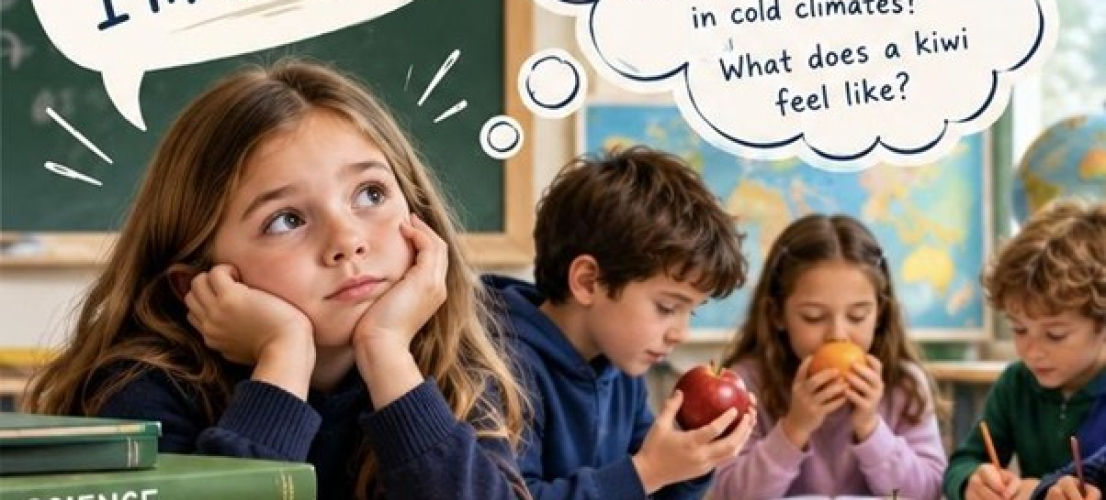
There was, however, one moment in the project that had not been genuinely planned. During an observation activity, the children were each given a whole fruit and a few minutes, without specific instructions. After an initial burst of enthusiasm came sighs and vacant stares conveying the inevitable question: “What now?”
We deliberately chose not to intervene immediately. Gradually, observations emerged that no worksheet could have elicited: Why are apples available all year round? Can bananas grow in cold climates? What does the skin of a kiwi feel like?
Some children began to classify the fruits by colour or taste, then by shape, and eventually by how much they “liked” them. From this initial boredom arose the freest and most personal thinking of the entire project. It also gave rise to the children’s curiosity about learning to prepare a delicious fruit salad in class.
What the Research Suggests
This is not merely an impression. The psychologists Sandi Mann and Rebekah Cadman (2014) demonstrated that participants who had completed a boring task subsequently performed better on divergent-thinking tests, that is, on measures of the capacity to generate multiple different solutions to the same problem. Benjamin Baird and colleagues (2012) reported a similar finding: allowing the mind to wander during a break facilitates the creative incubation of ideas.
In the field of education, Teresa Belton and Esther Priyadharshini (2007) urge schools to reconsider boredom not simply as an adversary to be overcome, but as an experience which, when appropriately supported, may lead children to seek stimuli and meaning within themselves. The psychoanalyst Adam Phillips (1993) characterises childhood boredom as a state of “suspended anticipation”, a period in which the child is unknowingly waiting for their own desire to emerge.
The Italian pedagogical tradition, moreover, had long recognised this. Gianni Rodari (1973) taught that imagination arises from the unexpected encounter between things, and Bruno Munari (1977) argued that creativity is not a mysterious gift but a skill developed by establishing connections among what one already knows. Establishing such connections, however, requires both time and space.
Slow Time, Even at the Table
A meaningful parallel can be drawn with food education. The Italian Ministry of Education’s guidelines (MIUR, 2015) emphasise the importance of a conscious relationship with food: recognising its origin, seasonality and flavour.
A fruit eaten hastily in front of a screen is a very different experience from one that is observed, smelled and savoured. Likewise, a thought “consumed” in haste differs from one that has been allowed to ripen.
Perhaps the most important lesson of this project lies precisely here: like fruit, ideas too need their season.
An Invitation to Families
The next time your children say “I’m bored”, try waiting a moment before suggesting something to do. You may discover that, when left alone with their thoughts (and perhaps with an apple in hand), children are capable of inventing ever new and different worlds.
Alessandro Ubbiali, CLIL Teacher
References
Baird, B., Smallwood, J., Mrazek, M. D., Kam, J. W. Y., Franklin, M. S., & Schooler, J. W. (2012). Inspired by distraction: Mind wandering facilitates creative incubation. Psychological Science, 23(10), 1117–1122.
Belton, T., & Priyadharshini, E. (2007). Boredom and schooling: A cross-disciplinary exploration. Cambridge Journal of Education, 37(4), 579–595.
Coyle, D., Hood, P., & Marsh, D. (2010). CLIL: Content and language integrated learning. Cambridge University Press.
Mann, S., & Cadman, R. (2014). Does being bored make us more creative? Creativity Research Journal, 26(2), 165–173.
MIUR. (2015). Linee guida per l'educazione alimentare [Guidelines for food education]. Ministero dell'Istruzione, dell'Università e della Ricerca.
Munari, B. (1977). Fantasia. Laterza.
Phillips, A. (1993). On kissing, tickling, and being bored. Harvard University Press.
Rodari, G. (1973). Grammatica della fantasia. Einaudi.