PRIMARIA SBS. Roll, Imagine, Write: three dice and a story

Mauro Ambrosini
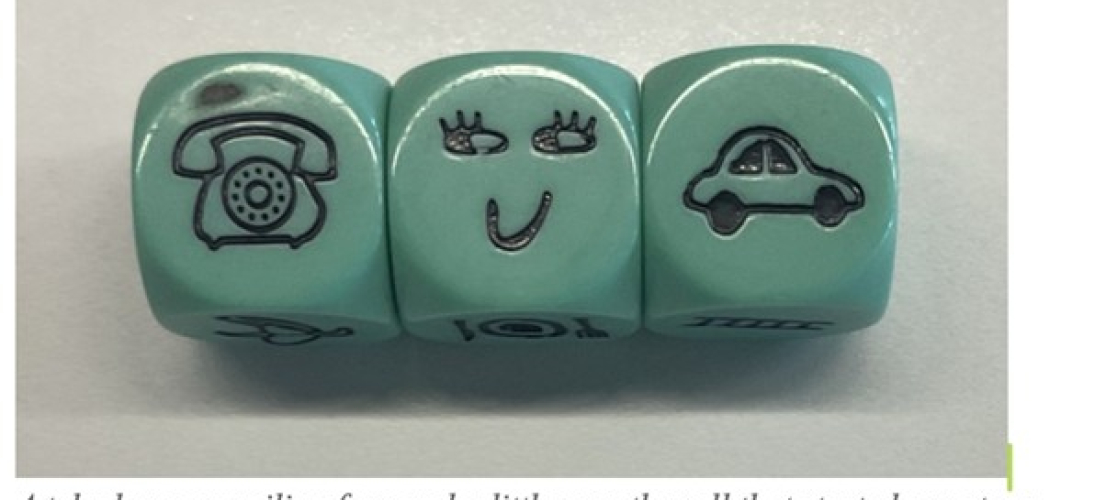
SINOSSI: Un telefono, un volto sorridente e una macchinina – tre dadi illustrati diventano il punto di partenza di un’attività di scrittura creativa in inglese per la classe quinta. A gruppi, i ragazzi scelgono le parole chiave e inventano una breve storia che colleghi le tre immagini: con lo stesso lessico nascono racconti sempre diversi. Il gioco si richiama al “binomio fantastico” di Rodari e al pensiero divergente e offre ai bambini un motivo autentico per usare la lingua, mentre il lavoro cooperativo permette a ciascuno di contribuire.
A telephone, a smiling face and a little car. Three small green dice on a desk, and a whole class of Year 5 pupils leaning forward to see what fate has chosen. This is how one of our English lessons began, and it turned into one of the liveliest writing sessions of the year. How the game works.
The rules are simple. A pupil rolls the dice and the class looks carefully at the pictures that appear. Then comes the vocabulary: sometimes the teacher provides the key words, and sometimes the children suggest them themselves, drawing on what they already know. A telephone quickly becomes phone, call, ring, talk. A face becomes happy, smile, laugh, friend. A car becomes drive, road, fast, trip.
Working in groups, the pupils then have one challenge: build a short story in English that connects all three pictures. The words are the same for everyone, yet every group produces a different story. One group might write: "The phone rings. It's Grandma! Lucy is very happy. She gets in the car with Dad and they drive to Grandma's house." Another might imagine a mysterious phone call, a secret smile and a car chase through the city.
Constraints that set imagination free
It may seem surprising that such a small set of pictures can produce so much creativity. Yet this is exactly the point. When anything is possible, a blank page can feel paralysing. When there are three random images to connect, the mind starts searching for links, and that search is where ideas are born. Gianni Rodari (1973) called this the binomio fantastico: two words that normally have nothing to do with each other, placed side by side, force our imagination to build a bridge between them. Psychologist J. P. Guilford (1950) described a similar process as divergent thinking, the ability to generate many possible answers to an open question. With our dice, a telephone, a smile and a car can become a birthday surprise, a lost dog, or a journey to the moon. Anna Craft (2000) reminds us that creativity is not only the gift of great artists. There is also a "little c" creativity, the everyday ability to find new ways through ordinary situations, and it can be nurtured in every primary classroom.
Language that has a purpose
For young learners of English, the game offers something precious: a real reason to use the language. Children are not writing sentences to practise a grammar rule; they are writing sentences because they want to tell their story. As Lynne Cameron (2001) observes, young learners engage most with a foreign language when it is embedded in meaningful activity. Stories are a natural home for this. Andrew Wright (1997) and Gail Ellis and Jean Brewster (2014) have shown how storytelling and story creation support vocabulary, sentence structure and confidence all at once, while respecting the children's own imagination. At A1 level, even simple sentences such as "He is happy" or "They drive to the park" become building blocks for a narrative that belongs to the children.
The power of the group
Working in groups adds another layer. Pupils negotiate ideas, correct each other, suggest a better word or a funnier ending. The stronger writers support those who are less confident, and everyone contributes something. This reflects what Lev Vygotsky (1978) described as the zone of proximal development: with the help of peers, children can achieve more than they could on their own. Research on cooperative learning (Johnson and Johnson, 1999) confirms that shared goals and individual responsibility make group work genuinely productive. At the end of the lesson, each group read its story aloud. The same three dice had produced a detective story, a family adventure and a very dramatic phone call from an alien. The children laughed, listened and, most importantly, wanted to roll again.
A game to try at home
You do not need special dice to play. Three pictures cut from a magazine, three objects taken from a drawer, or three drawings on scraps of paper will do the job. Pick them at random and ask your child: "What story connects them?" You may be surprised at the worlds that appear.
Alessandro Ubbiali, CLIL and English Teacher
References
Cameron, L. (2001). Teaching Languages to Young Learners. Cambridge: Cambridge University Press.
Craft, A. (2000). Creativity Across the Primary Curriculum: Framing and Developing Practice. London: Routledge.
Ellis, G., & Brewster, J. (2014). Tell It Again! The Storytelling Handbook for Primary English Language Teachers. London: British Council.
Guilford, J. P. (1950). Creativity. American Psychologist, 5(9), 444–454. Johnson, D. W., &
Johnson, R. T. (1999). Learning Together and Alone: Cooperative, Competitive, and Individualistic Learning (5th ed.). Boston: Allyn & Bacon.
Rodari, G. (1973). Grammatica della fantasia. Torino: Einaudi. [English edition: The Grammar of Fantasy, trans. J. Zipes. New York: Teachers & Writers Collaborative, 1996.]
Vygotsky, L. S. (1978). Mind in Society: The Development of Higher Psychological Processes. Cambridge, MA: Harvard University Press.
Wright, A. (1997). Creating Stories with Children. Oxford: Oxford University Press.
Per i nostri articoli utilizziamo immagini libere da diritti o scattate nella nostra scuola o fornite dai nostri insegnanti. Nel caso in cui utilizzassimo inavvertitamente foto coperte da copyright, la redazione si rende pienamente disponibile a rimuoverle immediatamente.